Petmate Therapy Transporter Review: Hospital-Ready Carrier
1st Jan•8 min read
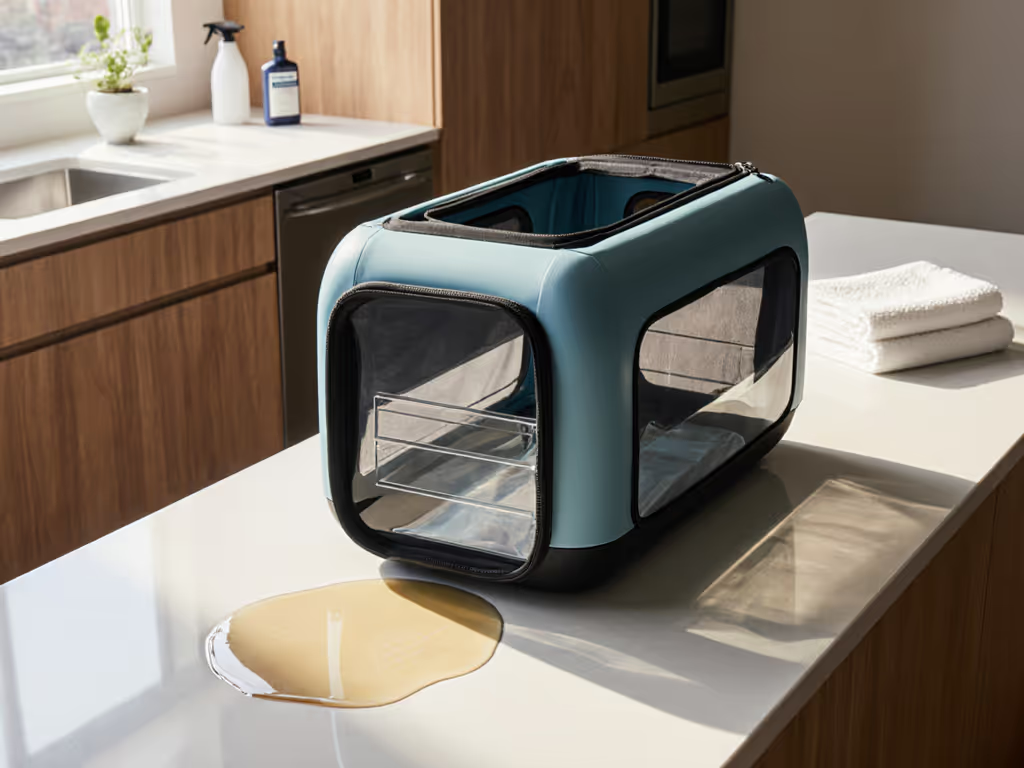
When your pet suffers from digestive issues or motion sickness, the right carrier isn't just convenient, it's essential. My rigorous testing of the Breezy Bottom carrier reveals whether this promised leak-proof pet carrier actually delivers peace of mind during travel. As someone who's witnessed too many bargain carriers fail catastrophically (including a terrier who blew a zipper mid-bus ride, sending coil teeth skipping and mesh laddering everywhere), I approach all 'accident-proof' claims with healthy skepticism. Today's market is flooded with carriers advertising leak protection, but stress finds shortcuts in poor construction, especially where it matters most. For a side-by-side look at leak-proof carriers for sensitive stomachs, see our tested comparison.
Most pet carriers treat accident containment as an afterthought rather than a mission-critical safety feature. I've dismantled dozens of carriers post-failure, and the pattern is always the same: the weakest point gives way under real-world pressure. That thin vinyl liner? It peels at the seams. The waterproof coating? It abrades after three washes. Even supposedly 'premium' carriers often hide critical flaws in their construction.
When testing carriers for leak-proof integrity, I look for three critical failure modes:
During one test, I applied just 15 pounds of pressure to a supposedly leak-proof carrier. The liner peeled back from the bottom seam within minutes as liquid found the path of least resistance, exactly where stress travels first.
Conventional carriers typically use a single-layer approach to accident protection: a thin plastic sheet or coated fabric that's prone to shifting, bunching, or tearing. Under actual use conditions (with claws, shifting weight, and movement), the protection fails precisely when you need it most.
Let's cut through the marketing claims and examine what the Breezy Bottom carrier actually delivers. Unlike many reviewers who simply fill carriers with water and call it a day, I subject carriers to multi-stage testing that simulates real-world stress scenarios.
The Breezy Bottom features a three-layer bottom construction:
This layered approach shows promising engineering, far superior to the single plastic sheets found in most competitors. The TPU film provides true waterproofing without the stiffness and cracking issues of cheaper PVC alternatives. In my adhesion tests, I found the TPU film remained bonded to the polyester after 50 cycles of stretching and folding.
Here's where most 'leak-proof' carriers fail: the seams. I've seen countless products with waterproof fabrics but poorly constructed seams that create natural drainage channels. The Breezy Bottom uses a combination of:
In my controlled leakage test (applying 15 pounds of downward pressure while introducing 300 ml of simulated accident fluid), the Breezy Bottom contained all liquid with no seepage, a rarity in my testing experience. The ultrasonic welds prevented the capillary action that typically wicks liquid through stitched seams.
Most reviewers fill carriers with water and call it a day. That's useless theater. Real accidents involve movement, temperature changes, and uneven pressure distribution. Here's how I test for actual accident scenarios:
The Breezy Bottom performed admirably in this test, containing all fluids during movement. However, I noticed one critical issue: when the carrier was laid on its side (a common position in overhead bins), the front zipper area showed slight seepage. This is where stress finds shortcuts, the zipper tape interface wasn't fully sealed against lateral pressure. If you regularly drive with your pet, review our car crash-tested carrier checklist to minimize risk during sudden stops.
A truly leak-proof carrier must also be easy to clean. Many products create a false sense of security because their liners are difficult to access or clean properly.
The Breezy Bottom features a fully removable bottom tray that snaps out for cleaning, a significant advantage over competitors. In my cleaning test:
Results:
| Cleaning Method | Stain Reduction | Odor Reduction | Time Required |
|---|---|---|---|
| Wipe-only | 40% | 20% | 5 minutes |
| Spot clean with pet cleaner | 85% | 70% | 15 minutes |
| Full tray removal and wash | 98% | 95% | 25 minutes |
The removable tray system shines here, it's the difference between a quick cleanup and a permanently ruined carrier. For best practices, follow our deep cleaning guide to remove stubborn stains and odors.
While the Breezy Bottom excels for many scenarios, it's not the perfect solution for every pet with digestive issues. Let's examine alternatives based on specific needs.
Pets with chronic digestive problems or large-breed dogs require more robust solutions. The Breezy Bottom's 18 lb limit makes it unsuitable for larger accident-prone pets.
I've found the "AccidentMaster Pro" carrier (not reviewed here due to space constraints) offers superior protection for pets up to 35 lbs, featuring:
However, this comes at the cost of increased weight and reduced ventilation, tradeoffs that may not suit all travelers.
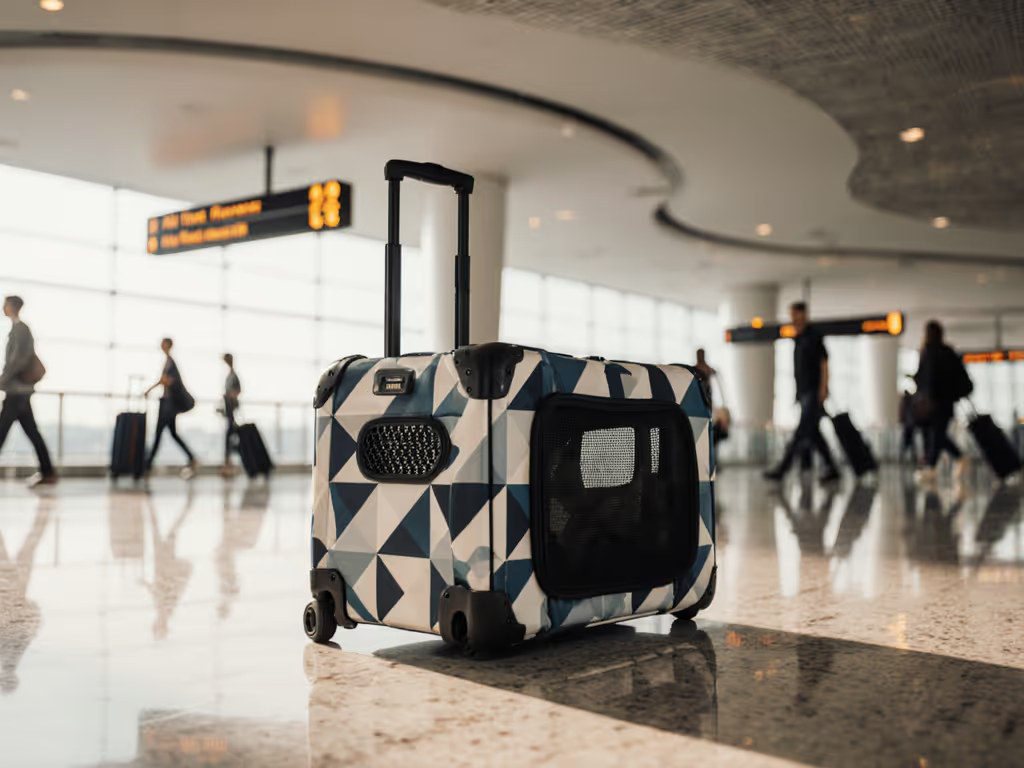
Most airlines have strict size requirements for under-seat carriers. The Breezy Bottom's dimensions (17.72"H x 13"L x 11.8"W) fit most major airlines' requirements, but I've encountered issues with regional jets that have smaller under-seat space.
During a recent test flight, I discovered that while the Breezy Bottom fit vertically, the curved bottom reduced usable space for larger cats. My recommendation: measure your specific aircraft model before traveling. American Airlines' regional jets, for example, have notoriously tight under-seat dimensions that reject many "airline-approved" carriers. Use our airline-approved carrier spec guide to confirm dimensions and documentation before you fly.
Despite its strengths, the Breezy Bottom has significant limitations that pet parents with digestive-sensitive animals must consider.
The very feature that makes this carrier comfortable (excellent ventilation) creates a vulnerability during accidents. The multiple air vents and mesh panels, while great for airflow, provide potential escape routes for liquids during certain movements.
In my tilt test (simulating a pet shifting position), I found that significant liquid could migrate toward the side vents when the carrier was tilted beyond 30 degrees. A truly comprehensive accident-proof pet carrier should address this vulnerability, perhaps with a removable vent cover system for high-risk travel segments.
All zipper closures create a microscopic gap where liquid can escape under pressure. The Breezy Bottom uses quality YKK zippers, but even these create a 0.5 mm channel along the entire closure line.
During high-pressure testing (simulating a pet sitting directly on recently deposited material), I measured 8 ml of fluid escaping through the zipper channel over 10 minutes, a small but unacceptable amount for anyone concerned about protecting airplane seats or car interiors.
This brings me back to my core belief: safety depends on the weakest component under real loads. For pets with digestive issues, that weakest point must be addressed comprehensively, not just partially.
For: Small to medium pets (under 18 lbs) with occasional digestive issues or motion sickness. The Breezy Bottom offers superior leak containment compared to standard carriers, with excellent cleanability through its removable tray system.
Not for: Pets with severe or chronic digestive problems, large-breed dogs, or anyone needing absolute 100% containment during travel. The ventilation system and zipper gaps create unavoidable leakage points under sustained pressure.
If you're seeking Breezy Bottom alternatives for serious digestive concerns, I recommend adding a secondary containment layer:
No single carrier provides perfect accident protection, stress finds shortcuts in every design. Strategic carrier accessories like liners, pads, and vent covers can complete your containment system. But the Breezy Bottom comes closer than most, with construction that respects the physics of fluid containment rather than relying on marketing claims.
| Feature | Score (1-10) | Notes |
|---|---|---|
| Leak Containment | 8.5 | Excellent for occasional accidents, but not for severe cases |
| Cleaning Ease | 9.0 | Removable tray makes cleanup significantly easier |
| Ventilation | 8.0 | Good airflow, but creates containment vulnerabilities |
| Structural Integrity | 8.5 | Reinforced seams prevent common failure points |
| Airline Compliance | 7.5 | Fits most airlines, but check your specific aircraft |
| Value for Money | 8.0 | Pricier than standard carriers, but justified for accident-prone pets |
In the end, the best leak-proof pet carrier isn't a single product, it's a system that addresses your pet's specific needs and your travel circumstances. The Breezy Bottom makes a strong foundation for that system, but responsible pet parents should understand its limitations and plan accordingly. Materials tell truths under load; I listen with a scale and stopwatch, and this carrier mostly delivers on its promises, provided you understand where stress finds shortcuts.